Tuesday, September 3, 2013

Thursday, August 12, 2010
Free help with math
Pre algebra online solver is an algebraic equation solving in step by step. Algebra is division of mathematics in that, letters are replaced by numbers. An algebraic equation stand for the scale, what is finished on the one side of a scale with a number is also completed to the other side of the scale. In this article we shall discuss for pre algebra online, also get more help with algebra 2 homework online
Solve the given samples pre algebra equation and find out x value of the equation.
3(3x - 2) + 4x = 2(4x + 5) – 11x
We are going to find the x value of the given pre algebra equation.
In the first we are going to multiply the term – 4x in both sides of the equation. We get
3(3x - 2) + 4x - 4x = 2(4x + 5) – 11x - 4x
3(3x - 2) = 2(4x + 5) – 15x
9x – 6 = 8x + 10 – 15x
In the next step grouping the same terms in the above equation, we get
9x – 8x + 15 x = 10 + 6
16x = 16
X = 1
The value of the x in a given equation is 1.
Tuesday, August 10, 2010
About new school notes
Planets are the largest objects in the solar system except for the sun. Unlike the sun, the planets do not produce their own energy. They reflect the heat and visible light produced by the sun. The four planets near the Sun - Mercury, Venus, Earth and Mars are called terrestrial (earth-like) planets because they are somewhat similar in size and composition to the earth. They appear to consist chiefly of iron and rock. The terrestrial planets and Pluto are the smallest planets. The earth has one satellite, Mars has two, and Pluto has one. Mercury and Venus have no satellites.
Also learn about grams to kilograms
The outer planets - Jupiter, Saturn, Uranus and Neptune are called the giant planets or Jovian planets. They are mainly made up of hydrogen, helium and ice. Compared to the terrestrial planets, they contain little iron and rock. Each of the giant planets has several satellites. They also have rings around them. However, only Saturn's large, bright rings can be easily seen through a small telescope.
Wednesday, July 21, 2010
Introduction to multiplying matrices
The rectangular arrangement of some numbers in some rows and columns is called matrix.
The scientist Sylvester defined matrix is a rectangular array or arrangement of entries or elements displayed in rows and columns put within a square bracket or parenthesis. The entries or elements may be any kind of numbers like real or complex, polynomials or other expressions. learn more on dividing polynomials Matrices are denoted by the capital letters like A, B, C.... The matrices use algebraic operations like addition, subtraction, multiplication and division. Let us see how to multiply the matrices in this article.
Any matrix A is denoted by Amxn (m by n), where m is the number of rows and n is the number of column in the matrix A and consists of m x n elements.
The rectangular arrangement of some numbers in some rows and columns is called matrix.
The scientist Sylvester defined matrix is a rectangular array or arrangement of entries or elements displayed in rows and columns put within a square bracket or parenthesis. The entries or elements may be any kind of numbers like real or complex, polynomials or other expressions. learn more on dividing polynomials Matrices are denoted by the capital letters like A, B, C.... The matrices use algebraic operations like addition, subtraction, multiplication and division. Let us see how to multiply the matrices in this article.
Any matrix A is denoted by Amxn (m by n), where m is the number of rows and n is the number of column in the matrix A and consists of m x n elements.
Amxn = 
The number of rows and number of columns m x n (m by n) gives the size of the Matrix.
For example: A =  has 2 rows and 3 columns, so the size of matrix A is 2 x 3 (2 by 3).
Saturday, July 17, 2010
Leraning Geometric Sequence
A sequence is a collection of numbers is called as terms, arranged in some particular order. There are several types of sequences; one of the most frequent sequences is the geometric sequence and series.
In mathematics, a geometric sequence is otherwise known as a geometric progression, is a sequence of numbers where each term after the first is found by multiplying the previous one by a fixed non-zero number called the common ratio. For example, if the sequence is 1, 4, 16, 64... here the common ratio is 3 in the geometric progression. Similarly 10, 5, 2.5... is also a geometric sequence with common ratio ½ .
The addition of all the terms in geometric sequence is known as a geometric series.
Thursday, May 27, 2010
The Ellipse and Circle
Definition of Ellipse and Circle
Ellipse
The locus of a point in a plane whose distance from a fixed point bears a constant ratio, less than one to its distance from a fixed line is called ellipse. An ellipse is the set of all points (x, y) in the plane such that the sum of the distances from (x, y) to two fixed points is some constant. The two fixed points are called the foci, which is the plural of focus.

Circle
A circle is the locus of a point which moves in such a way that its distance from a fixed point is always constant. The fixed point is called the centre of the circle and the constant distance is called the radius of the circle.
Geometric Construction
The geometric construction of an ellipse can easily be accomplished with some very simple tools: a piece of string, a pencil, two pins, and a piece of paper. Simply stick the two pieces of string into the piece of paper using the two pins. Pull the string tight (using the pencil) until a triangle is built with the pencil and the two pins as vertices. Now, keeping the string pulled tight, move the pencil around until the ellipse is traced out.

Example: Consider the equation Given our comments above, this equation yields an ellipse. We see that and and the graph of this ellipse is the following:
Consider the equation
Given our comments above, this equation yields an ellipse. We see that
a=5
and
b=3
and the graph of this ellipse is the following:

Ellipse
The locus of a point in a plane whose distance from a fixed point bears a constant ratio, less than one to its distance from a fixed line is called ellipse. An ellipse is the set of all points (x, y) in the plane such that the sum of the distances from (x, y) to two fixed points is some constant. The two fixed points are called the foci, which is the plural of focus.
Circle
A circle is the locus of a point which moves in such a way that its distance from a fixed point is always constant. The fixed point is called the centre of the circle and the constant distance is called the radius of the circle.
Geometric Construction
The geometric construction of an ellipse can easily be accomplished with some very simple tools: a piece of string, a pencil, two pins, and a piece of paper. Simply stick the two pieces of string into the piece of paper using the two pins. Pull the string tight (using the pencil) until a triangle is built with the pencil and the two pins as vertices. Now, keeping the string pulled tight, move the pencil around until the ellipse is traced out.
Example: Consider the equation Given our comments above, this equation yields an ellipse. We see that and and the graph of this ellipse is the following:
Consider the equation
Given our comments above, this equation yields an ellipse. We see that
a=5
and
b=3
and the graph of this ellipse is the following:
Wednesday, May 26, 2010
Polynomial Graphs: End Behaviour
Polynomial Graphs
When we are graphing (or looking at a graph of) polynomials, it can help to already have an idea of what basic polynomial shapes look like. One of the aspects of this is "end behavior", and it's pretty easy. Look at these graphs:


As you can see, even-degree polynomials are either "up" on both ends (entering and then leaving the graphing "box" through the "top") or "down" on both ends (entering and then leaving through the "bottom"), depending on whether the polynomial has, respectively, a positive or negative leading coefficient. On the other hand, odd-degree polynomials have ends that head off in opposite directions. If they start "down" (entering the graphing "box" through the "bottom") and go "up" (leaving the graphing "box" through the "top"), they're positive polynomials; if they start "up" and go "down", they're negative polynomials.
All even-degree polynomials behave, on their ends, like quadratics, and all odd-degree polynomials behave, on their ends, like cubics.
When we are graphing (or looking at a graph of) polynomials, it can help to already have an idea of what basic polynomial shapes look like. One of the aspects of this is "end behavior", and it's pretty easy. Look at these graphs:
As you can see, even-degree polynomials are either "up" on both ends (entering and then leaving the graphing "box" through the "top") or "down" on both ends (entering and then leaving through the "bottom"), depending on whether the polynomial has, respectively, a positive or negative leading coefficient. On the other hand, odd-degree polynomials have ends that head off in opposite directions. If they start "down" (entering the graphing "box" through the "bottom") and go "up" (leaving the graphing "box" through the "top"), they're positive polynomials; if they start "up" and go "down", they're negative polynomials.
All even-degree polynomials behave, on their ends, like quadratics, and all odd-degree polynomials behave, on their ends, like cubics.
Basic Identities
Basic Identities of Algebra
Closure Property of Addition
Sum (or difference) of 2 real numbers equals a real number
Additive Identity
a + 0 = a
Additive Inverse
a + (-a) = 0
Associative of Addition
(a + b) + c = a + (b + c)
Commutative of Addition
a + b = b + a
Definition of Subtraction
a - b = a + (-b)
Closure Property of Multiplication
Product (or quotient if denominator 0) of 2 reals equals a real number
Multiplicative Identity
a * 1 = a
Multiplicative Inverse
a * (1/a) = 1 (a 0)
(Multiplication times 0)
a * 0 = 0
Associative of Multiplication
(a * b) * c = a * (b * c)
Commutative of Multiplication
a * b = b * a
Distributive Law
a(b + c) = ab + ac
Definition of Division
a / b = a(1/b)
Closure Property of Addition
Sum (or difference) of 2 real numbers equals a real number
Additive Identity
a + 0 = a
Additive Inverse
a + (-a) = 0
Associative of Addition
(a + b) + c = a + (b + c)
Commutative of Addition
a + b = b + a
Definition of Subtraction
a - b = a + (-b)
Closure Property of Multiplication
Product (or quotient if denominator 0) of 2 reals equals a real number
Multiplicative Identity
a * 1 = a
Multiplicative Inverse
a * (1/a) = 1 (a 0)
(Multiplication times 0)
a * 0 = 0
Associative of Multiplication
(a * b) * c = a * (b * c)
Commutative of Multiplication
a * b = b * a
Distributive Law
a(b + c) = ab + ac
Definition of Division
a / b = a(1/b)
Tuesday, May 25, 2010
The "Vertical Line Test"
The "Vertical Line Test"
-->
Vertical line test is relation between two terms of X and Y. And this test used to determine If a relation is a function. If that shows no vertical lines and that intersect the graph at more than one point, the relation for each element of the domain are corresponding to exactly one element of the range.
Types of lines
Line:
The infinitely long and thin of the straight geometrical object is called line. Types of lines can be classified into following types:
Line:
The infinitely long and thin of the straight geometrical object is called line. Types of lines can be classified into following types:
- Straight Line
- Vertical line
- Horizontal line
Looking at this function stuff graphically, what if we had the relation that consists of a set containing just two points: {(2, 3), (2, –2)}? We already know that this is not a function, since x = 2 goes to each of y = 3 and y = –2.
 This characteristic of non-functions was noticed by I-don't-know-who, and was codified in "The Vertical Line Test": Given the graph of a relation, if you can draw a vertical line that crosses the graph in more than one place, then the relation is not a function. Here are a couple examples:

Thursday, May 20, 2010
Types Of Vectors
Vector: A quantity that has magnitude as well as direction is called a vector.
Different types of vectors are,
a) Zero or Null Vector: A vector whose initial and terminal points coincide, is called a zero vector (or null vector).
b) Unit vector: vector whose magnitude is unity (i.e., 1 unit) is called a unit vector.
c) Collinear Vectors: Two or more vectors are said to be collinear if they are parallel to the same line, irrespective of their magnitudes and directions.
d) Co-initial vectors:Two or more vectors having the same initial point are called coinitial vectors.
e) Negative of a Vectors: A vector whose magnitude is the same as that of a given vector, but direction is opposite to that of it, is called negative of the given vector.
f) Equal Vectors: Two vectors are said to be equal, if they have the same
magnitude and direction regardless of the positions of their initial points,
magnitude and direction regardless of the positions of their initial points,
Linear functions and Inequalities
Introduction to linear functions and inequalities:
In mathematics, the term linear function can refer to either of two different but related concepts:
- a first-degree polynomial function of one variable;
- a map between two vector spaces that preserves vector addition and scalar multiplication.
In mathematics, an inequality is a statement about the relative size or order of two objects or about whether they are the same or not
- The notation a <>less than b.
- The notation a > b means that a is greater than b.
- The notation a ≠ b means that a is not equal to b, but does not say that one is greater than the other or even that they can be compared in size.
Solve the expression
5(-3y - 2) - (y - 3) = - 4(4y + 5) + 13
Solution:
• Given the equation
5(-3y - 2) - (y - 3) = -4(4y + 5) + 13
• Multiply factors.
-15y - 10 - y + 3 = -16y - 20 +13
• Group like terms.
-16y - 7 = -16y - 7
• Add 16y + 7 to both sides and write the expression as follows
0 = 0
• The above statement is true for all values of y and therefore all real numbers are solutions to the given equation.
Inequalities - Example :
Solve 4x + 3 <>
Solution:
4x + 3 <>
4x +3 – 3 <>
4x <>
4x – 8x <>
- 4x <>
x > – 1
The solution set is {0, 1, 2, 3…}
Polynomials
Introduction Of polynomials
A polynomial is a mathematical expression and it consist of a addition of terms. Each term may contains of a variables and variables with raised powers. The example of a polynomial is as follows:
AX 3 + BX 2 + CX, AX 3 + BY2The operations that are performed on the polynomials are,
- Adding Polynomials,
- Subtracting Polynomials,
- Multiplying Polynomials, and
- Dividing Polynomials.
Addition of Polynomials:
We add two polynomials adding the coefficients of the like powers.
Example :
Find the sum of Polynomials - 2x4 – 4x2 + 6x + 3 and 4x + 6x3 – 6x2 – 1.
Solution:
(-2x4 – 4x2 + 6x + 3) + (6x3 – 6x2 + 4x – 1) = - 2x4 + 6x3 – 4x2 – 6x2 + 6x + 4x + 3 – 1
(By using distributive and associative property)
= - 2x4 + 6x3 – (4 + 6) x2 + (6 + 4) x + 2 (By arranging the coeeficient of same exponent)
= - 2x4 + 6x3 – 10x2 + 10x + 2 (Adding the coefficient of coresponding exponent)Answer of the given polynomial: - 2x4 + 6x3 – 10x2 + 10x + 2
Wednesday, April 7, 2010
Hexagon, Cylinder Volume – Geometry Problems
GEOMETRY:
QUESTION:11
Find the volume of hexagon and cylinder. The cylinder has 7cm as height and radius is 4cm.
The hexagon exactly fits inside the cylinder.
Solution:
The volume of cylinder is = pie r^2 h
Here, r = 4cm
And h = 7cm
So, the volume of cylinder is = pie * 4*4*7 cm^3
= 112 pie cm^3
Now,
The volume of hexagon exactly fits inside the cylinder:
The volume of hexagon is base area * height.
Base area:
using sine law we can find base area. The regular hexagon
has 120 degree as interior angle. So, the triangle we drawn
through the center of the circle is equilateral triangle. The
radius is 4cm.
using. Sine law
sin 90 sin 30
------ = -------
4 x
1 0.5
-- = ---
4 x
X = 2cm
the length of the side of the hexagon is 2+2cm = 4cm.
the base area of the hexagon is:
3 root 3
--------- side^2
2
3 root 3
---------- * 4*4cm^2
2
=24 root 3.
The volume of the hexagon is:
= base area * height
= 24 root 3 cm^2 * 7 cm
= 168 root 3 cm^3
GEOMETRY:
QUESTION:12
Find the sides of a square if AM = 8cm
Solution:
According to the properties of a square, the diagonals bisect each
other. So,
AM = MC
AC = AM + MC
AC = 8cm + 8cm
AC = 16cm.
Using pythagoras theorem,
Take AB = x
x^2 + x^2 = 16^2
2x^2 = 256
x^2 = 128
x = 11.314.
Side of the square is 11.314cm
Algebra word problems – part 2
ALGEBRA:
QUESTION:13
Find the Area of a rectangle the length of a rectangle is 3 more and 3 times the width of the
Rectangle.
Solution:
Take the Width as x cm
And the Length is three times and 3 more than
The Width. So, Length is 3x+3.
The Area of a Rectangle is:
Length * Width
(3x+3) ( x)
Expand the terms,
3x^2 +3x <------------- Answer.
AlGEBRA:
QUESTION: 14
Find (k^9)^-5 when k = 0.
Solution:
Using Exponent Law we can simplify the expression ,
K^9*-5 = k ^ -45 = 1/ k^45
If k =0 the value is undefined.
Geometry example ptoblems
GEOMETRY:
QUESTION : 15
If cos teta = ¾ and is in the fourth quadrant, find sin teta.
Solution:
Using pythagoras theorem,
3^2 + y^2 = 4^2
9 + y^2 = 16
y^2 = 16 - 9
y = +/- root of 7
Here,
y lies in the fourth quadrant so, it takes the value -ve root 7.
Sin teta = root 7/4.
GEOMETRY
QUESTION: 16:
Find Tan (75) using sum or difference angle method.
Solution:
Tan 75 = tan (45 + 30)
tan x + tany
tan(x+y ) = ---------------
1- tanx. Tany
Using the above method
Tan 45 + tan 30
Tan(45+30) = ----------------------
1- tan45. tan 30
1+ 1/ 3
= ------------------
1- 1. 1/ 3
GEOMETRY:
QUESTION : 17:
Find sin 75 using sum or difference of angle method.
Solution:
Sin 75 = sin (45 + 30)
Sin (x+ y) = sinx cosy + cosx siny.
Sin(45 + 30) = sin 45 cos 30 + cos 45 sin 30.
Ratio , completing square problems in Algebra
ALGEBRA I:
QUESTION: 18
Find the ratios . a = 4b
Solution:
a = 4b
so, b = ¼ a
The ratio of a:b is 4:1
ALGEBRA
QUESTION:19
Find the ratio of a and b. 4a + 2b = 0.
Solution:
We can solve the equation,
4a + 2b = 0
4a = -2b
Divide both sides by -2
-2a = b
The ratio of a: b is equal to -1/2 : 1 or -1 : 2
ALGEBRA
QUESTION:20
Factor trinomial 28x^2 - 33x - 28
Solution:
28x^2 - 33x - 28. Procedure for splitting middle term
To factor this trinomial, Product of coefficient of x^2 and constant = -784
Split the middle term, sum of the factors of -784 = -33
Using this method we couldn't factor the given trinomial
exactly with whole numbers. So, use quadratic formula
to find the factors.
Use quadratic formula here,
-b +/- root (b^2 - 4ac)
x = -----------------------------
2a
Here, a = 28, b= -33 and c - -28
Plug in the values of a , b and c in the formula,
-(-33) +/- (1089) + 3136
x = ----------------------------------
2(28)
33+/- 4225
x = ----------------
56
x = (33+/- 65)/ 56
x = 98/56 or x = -32/56
x = 1.75 or x = -0.57
The factors are (x- 1.75) (x+0.57)
ALGEBRA
QUESTION:21
Find the solution using completing square method.
x^2 + 10x -9 = 0
Solution:
x^2 + 10x - 9 = 0
x^2 + 2.x.5 -9 =0
Here, to complete the square, just add 5^2 and subtract 5^2 in the left side of the equation.
x^2 + 10x +5^2 - 5^2 -9 = 0
Using the identity (a+b)^2 = a^2 +2ab + b^2
We can write x^2 + 10x + 5^2 as (x+5)^2
For the given equation,
(x+5)^2 - 25-9 = 0
(x+5)^2 -34 = 0
(x+5)^2 = 34
To solve for x
(x+5)(x+5) = 34
x+5 = 34 or x+5 = -34
x = 34 -5 = 29 or x = -34-5 = -39.
x = 29 or x = -39
ALGEBRA
QUESTION: 22
Find the solution using completing square method.
x^2- 6x + 9 = 1
Solution:
x^2 - 6x +9 = 1
x^2 - 2.x.3 + 3^2 =1
The left side of the equation is already in complete squared form, here,
We no need to add or subtract anything.
We can write x^2-6x +9 = (x-3)^2
For the given equation,
(x - 3)^2 = 1
To solve for x
(x-3)(x-3) = 1
x -3 = 1 or x-3 = -1
x = 1+3 or x = -1+3
x = 4 or x = 2.
Probability and Algebra Example word problems
PROBABILITY:
QUESTION: 23
Keisha is playing a game using a wheel divided into eight equal sectors as shown in the diagram below each time the spinner lands on orange she will win a prize. If Keisha spins the wheel twice what is the probablity she will win a prize on both spins.
W- White
O - Orange
Br - Brown
Y - Yellow
G - Green.
Bl - Blue.
Solution:
The Probability of winning a prize is:
Outcome favourable to the event
= ---------------------------------------
Total number of outcomes
= 1/8 + 1/8 = 2/8
= ¼
ALGEBRA I
QUESTION : 24
Divide the rational expressions:
3x+6 x^2 - 4
------- ---------
4x+12 x+3
Solution:
Factor each expression
3x+6 take out 3 as the common factor. So, 3(x+2)
4x+12 take out 4 as the common factor. So, 4(x+3)
X^2 -4 = x^2 - 2^2
Using the identity a^2-b^2 = (a+b)(a-b)
Factor x^2- 2^2 = (x+2)(x-2)
Apply all these factor form in the place of it's expression
Then the rational division is just inversing the denominator and multiply
With the numerator
3(x+2) x+3
------- * -----------
4(x+3) (x+2)(x-2)
Solve this, we will get
3
-------
4(x-2) as solution.
ALGEBRA I
QUESTION:25.
The price per person to rent a limo for a prom varies inversely as the number of passengers. If 5 people rent a limo, the cost is $70 each. How many People are renting the limo when the cost per couple is $87.5.
Solution:
Rent per person cost
x y
5 $70
x2 $87.5
Here, x2 represent number of couples. From the problem it uses inverse variation formula here,
x1 y2
--- = --
x2 y1
5 87.5
-- = ------ [ cross multiply, solve for x2]
x2 70
x2 = 4
Rent for 4 couples is $87.5.
Algebra Problems
ALGEBRA:
QUESTION: 27
Graph for the given. Slope m = -1 and y-intercept b = 6
Solution:
We can find the x intercept using the given slope and y intercept.
y-intercept is 6 so, it is (0,6)
to find x intercept use the formula,
y2-y1
------- = m = slope
x2-x1.
Take x intercept as (x,0)
Here apply the x and y intercept values in the formula to find the x intercept of the equation.
6-0
----- = -1
0-x
Solve for x, we will get x =6.
So, here we found x intercept as (6,0)
Now, we can draw Graph for these x and y intercepts.
Wednesday, December 2, 2009
How to find Simple Interest in Algebra
In Algebra tutoring ,Interest is a fee paid on borrowed assets. It is the price paid for the use of borrowed money, or, money earned by deposited funds. Assets that are sometimes lent with interest include money, shares, consumer goods through hire purchase, major assets such as aircraft, and even entire factories in finance lease arrangements. The interest is calculated upon the value of the assets in the same manner as upon money. Interest can be thought of as "rent of money". When money is deposited in a bank, interest is typically paid to the depositor as a percentage( how to find percentage) of the amount deposited; when money is borrowed, interest is typically paid to the lender as a percentage of the amount owed. The percentage of the principal that is paid as a fee over a certain period of time (typically one month or year), is called the interest rate.Let's see an example from algebra 1 word problems
Question:-
A city government built a $60 million sports arena.Some of the money was raised by selling bonds that pay simple interest at a rate of 11% annually.The remaining amount was obtained by borrowing money from an insurance company at a simple interest rate of 10% .How much was financed through the insurance company if the annual interest is $6.19 million?
Answer:-
Let $x was financed through the insurance company.
Then $(60-x) was raised through selling bonds.
Interest on $(60-x) for 1 year at 11% is (60-x).11/100
And interest on $x for 1 year at 10% is x.10/100
By the problem
[11(60-x)/100] + [10x/100] = 6.19
multiplying both sides by 100 , we get
11(60-x)+10x = 619
660-11x+10x = 619
660 - x = 619
x = 41
So,$41 was financed through the insurance company.
Question:-
A city government built a $60 million sports arena.Some of the money was raised by selling bonds that pay simple interest at a rate of 11% annually.The remaining amount was obtained by borrowing money from an insurance company at a simple interest rate of 10% .How much was financed through the insurance company if the annual interest is $6.19 million?
Answer:-
Let $x was financed through the insurance company.
Then $(60-x) was raised through selling bonds.
Interest on $(60-x) for 1 year at 11% is (60-x).11/100
And interest on $x for 1 year at 10% is x.10/100
By the problem
[11(60-x)/100] + [10x/100] = 6.19
multiplying both sides by 100 , we get
11(60-x)+10x = 619
660-11x+10x = 619
660 - x = 619
x = 41
So,$41 was financed through the insurance company.
Wednesday, August 26, 2009
Equation of a line by using pythagoras theorem
Pythagorean theorem is important triangle formula which is a relation in Euclidean geometry among the three sides of a right triangle (right-angled triangle in British English). It states:
Question:-
Find the distance between two points R(5,1) and S(-3,-3)
Answer:-
Let's solve this by using a graph,so that we can draw the line by using the given points and we can make use of Pythagoras theorem to find the distance between them.
(RS)2=(RT)2+(ST)2
(RS)2=42+82
(RS)2=16+64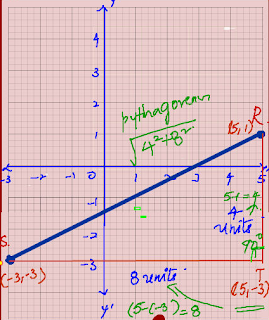
(RS)2=80
RS = √80
similarly ,we can find all points having an x-coordinate of 2 whose distance from the point 2 1 is 5
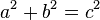
In any right triangle, the area of the square whose side is the hypotenuse (the side opposite the right angle) is equal to the sum of the areas of the squares whose sides are the two legs (the two sides that meet at a right angle).we use this in most trigonometry examplesThe theorem can be written as an equation:

Question:-
Find the distance between two points R(5,1) and S(-3,-3)
Answer:-
Let's solve this by using a graph,so that we can draw the line by using the given points and we can make use of Pythagoras theorem to find the distance between them.
(RS)2=(RT)2+(ST)2
(RS)2=42+82
(RS)2=16+64

(RS)2=80
RS = √80
similarly ,we can find all points having an x-coordinate of 2 whose distance from the point 2 1 is 5
Subscribe to:
Comments (Atom)